How to Build Team Trust | Why Trust Drives Performance at Work

Key Takeaways
Trust is built through consistent actions, not one-time gestures
Psychological safety is the foundation of high-trust teams
Leaders strengthen trust by modelling transparency and accountability
Small daily behaviours have more impact than big symbolic initiatives
Trust directly improves engagement, collaboration, and retention
Trust directly shapes how quickly teams move, how well decisions are made, and how long people choose to stay. When trust is low, work slows in ways that are often invisible but deeply costly—decisions drag, mistakes go unspoken, and capable people disengage or leave.
In KindCo’s trust survey, 45% of respondents reported leaving a job specifically because of low trust. That loss shows up not just in turnover but also in productivity gaps, repeated rework, fractured collaboration, and the quiet erosion of institutional knowledge, long before it appears on a balance sheet.
Trust isn’t a cultural abstraction. It is an operating condition that directly affects speed, risk, and results.
This article explores how to build team trust from a business perspective, grounded in two respected frameworks:
Charles Feltman’s behavioural model of trust from The Thin Book of Trust.
The core principle behind The Speed of Trust: trust lowers cost and accelerates execution
At the same time, it reflects a simple truth leaders experience every day: performance follows experience. How people experience work determines how well the organization performs.
What Does Trust on a Team Really Mean?
On a trusting team, people don’t have to armour up. They don’t spend energy protecting themselves or reading between the lines.
Instead, they trust that:
What’s said is meant
Commitments matter
People are capable and supported
Decisions consider human impact, not just outcomes
Trust doesn’t mean everyone agrees. It means people believe they can be honest without being punished—and that others will show up with integrity.
Why Team Trust Is a Business Issue
When trust is present, work feels lighter, even when it’s complex. Communication is clearer. Feedback is easier. Decisions happen without endless looping.
When trust is missing, people withdraw. Meetings get quieter. Email gets longer. Everything takes more effort.
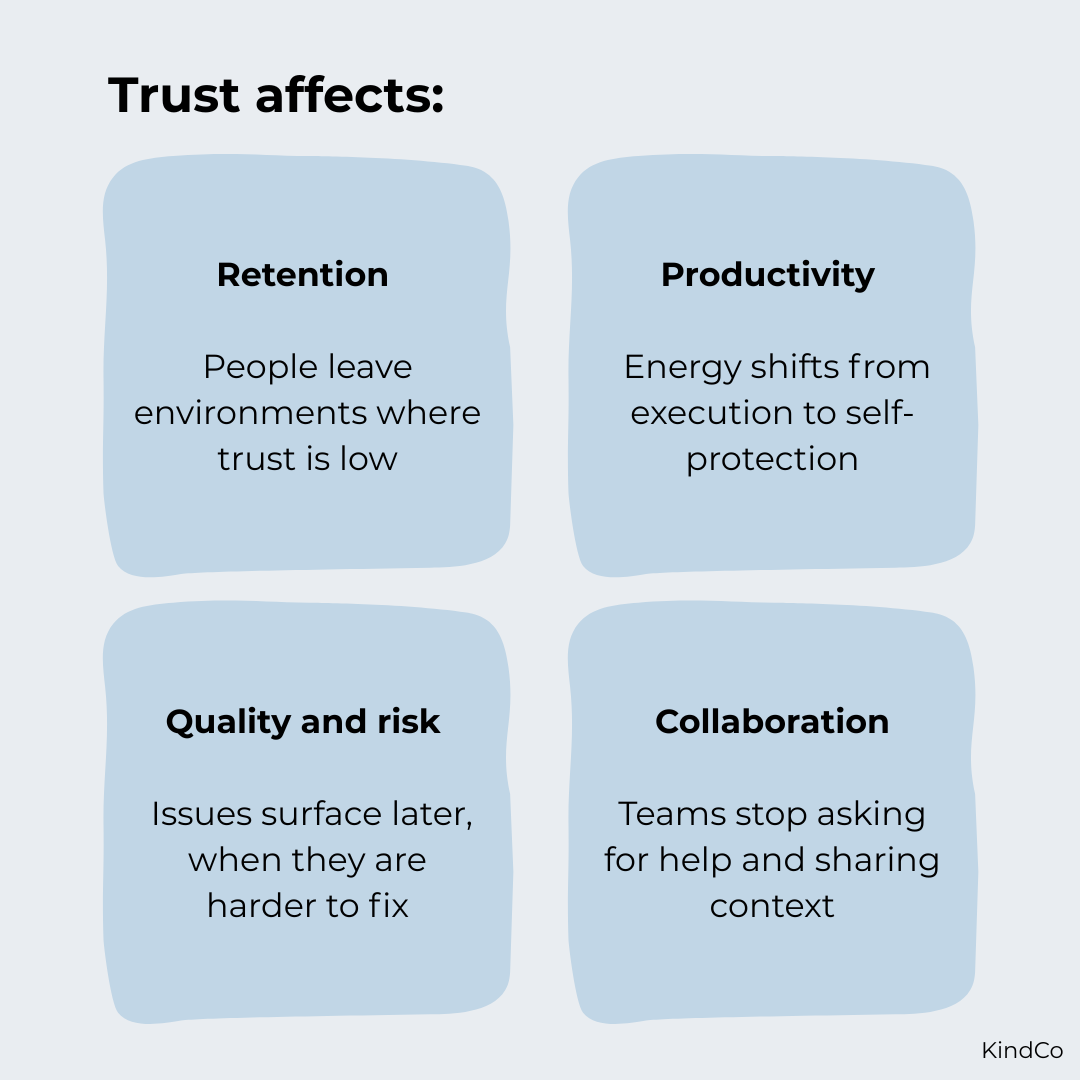
Trust affects:
Retention – people leave environments where trust is low
Productivity – energy shifts from execution to self-protection
Quality and risk – issues surface later, when they are harder to fix
Collaboration – teams stop asking for help and sharing context
Trust isn’t a “nice to have.” It’s a performance issue.
The Four Distinctions of Trust
Charles Feltman describes trust as a set of observable behaviours. This matters because it makes trust practical—something leaders and teams can actively build, assess, and repair.
1. Sincerity: Saying What You Mean, Meaning What You Say
Sincerity is about alignment between words and actions. People trust leaders and teammates who are honest, transparent, and consistent, especially when trade-offs are involved.
What sincerity looks like on a team:
Sharing what’s true, even when it’s uncomfortable
Being clear about constraints and priorities
Naming mistakes without blame or spin
Not having the meeting after the meeting
A useful example comes from Jersey Mike’s. When the company was sold for billions, leaders pointed back not to branding or short-term tactics, but to decades of consistent behaviour, how people were treated, how decisions were made, and how values held under pressure. That alignment built internal trust long before it was rewarded externally.
When sincerity is present, people don’t have to guess what’s really going on.
2. Reliability: Following Through in Ways People Can Count On
Reliability builds trust quietly over time. It’s about consistency, not perfection.
What reliability looks like on a team:
Making realistic commitments
Being clear about ownership
Letting others know early when plans need to change
Reliability tells people: you matter enough for me to keep my word, or to renegotiate respectfully.
This is the distinction most people think of when they think about trust at work. It can seem black-and-white; either a commitment was met, or it wasn’t. In practice, it’s often more grey.
What we consistently see is that the rigour behind clarifying commitments is missing. People can’t meet expectations that were never clearly defined and mutually agreed upon. Reliability improves dramatically when expectations are explicit, shared, and revisited as conditions change.
3. Competence: Feeling Confident in One Another’s Capability
Trust grows when people believe the team has the skills and judgment needed to do the work, and the support to keep learning.
What competence-based trust looks like:
People are placed in roles that fit their strengths
Learning and feedback are normalized
Asking for help is welcomed, not judged
Competence isn’t about knowing everything. It’s about being honest about what you know and what you’re still learning.
A common pitfall is assuming management competence based on success in an individual contributor role. For example, strong project management skills don’t automatically translate into effective people leadership. Management training and support are often required to ensure success in a new role.
4. Care: Knowing People Matter Beyond Their Output
Care is the heart of trust. It’s about showing that people aren’t interchangeable: they’re human.
What care looks like on a team:
Listening with attention, not interruption
Acknowledging capacity, stress, and life outside of work
Making decisions with fairness and empathy
Care doesn’t remove accountability. It grounds it in respect.
Because care is easily crowded out by urgency, it often requires deliberate practice. One practical tip from Zach Mercurio, author of The Power of Mattering, is to carry one follow-up question into each meeting that is grounded in care—something that signals people matter, not just outcomes.
How Leaders Can Nurture Trust on Their Teams
Trust is shaped every day by how leaders show up.
Small, consistent choices matter more than grand gestures:
Model openness – say what you’re learning, not just what you know
Create clarity – reduce uncertainty where you can
Invite voice – ask for input and respond thoughtfully
Address tension early – unspoken issues quietly erode trust
Leadership isn’t about having all the answers. It’s about creating conditions where people feel safe enough to contribute fully.
Rebuilding Trust When It’s Been Hurt
Trust can be repaired, but only through genuine care and consistent action.
An effective repair process includes:
Naming what happened, clearly and calmly
Taking responsibility without defensiveness
Acknowledging the impact on people and the work
Making a new commitment and keeping it
Repair is less about saying the perfect words and more about showing change over time.
Keeping Trust Alive Over Time
Trust isn’t static. It needs attention, especially during change or pressure.
Helpful practices include:
Regular check-ins that ask how people are, not just what they’re doing
Retrospectives that focus on learning, not blame
Feedback loops that feel safe and respectful
When trust is tended to, teams become more resilient, not because work is easy, but because people feel supported.
Trust Is a Human Practice
Building team trust isn’t about control or compliance. It’s about care, clarity, and consistency.
When people feel seen, heard, and valued, they bring more of themselves to their work. They collaborate more openly. They stay longer. They grow.
Trust is what makes humanizing work possible and what enables teams to do meaningful work together.
Frequently Asked Questions About Building Team Trust
What builds trust on a team?
Team trust is built through consistent behaviour over time. The strongest drivers are clarity of intent, reliable follow-through, demonstrated competence, and visible care for people affected by decisions. Trust grows when words and actions align, commitments are kept or renegotiated early, and people feel safe raising concerns.
Why is trust important for team performance?
Trust directly affects speed, decision quality, and risk. High-trust teams surface issues earlier, collaborate more effectively, and require less oversight. Low trust creates hidden costs through disengagement, rework, and higher turnover.
How can leaders rebuild trust after it’s been broken?
Rebuilding trust requires acknowledgment, responsibility, and consistent follow-through. Leaders must clearly name what happened, recognize the impact, and demonstrate change through sustained behaviour, not just apologies.
How long does it take to build trust on a team?
Trust is built incrementally and can be damaged quickly. While small trust-building behaviours have an immediate impact, durable trust develops through repeated, predictable actions over time, especially during moments of pressure or change.
What are the biggest causes of low trust at work?
Low trust is most often caused by broken commitments, unclear communication, inconsistent decision-making, and a lack of follow-through. When people feel decisions are made without transparency or regard for impact, trust erodes quickly.
Ready to Build Trust Together?
If you want help applying these trust distinctions with your team, in practical, interactive sessions, our KindCo Trust Workshop gives your group shared language, tools, and agreements that lead to faster decisions and stronger collaboration. Learn more about our trust workshop.